



What is the notation based on the Specified Commercial Transactions Act? Explanation of how to write it, regulations, and penalties

The Specified Commercial Transactions Act requires businesses to post "notation based on specified commercial transactions" such as the name of the operating company and the person in charge of store operations on their e-commerce websites. E-commerce sites are subject to this law (there are exceptions), regardless of the products or industry they handle, so anyone planning to open an e-commerce site should be sure to understand it.
Here, we will provide an easy-to-understand explanation of the outline of the Specified Commercial Transactions Act, as well as the items and writing methods of notation based on the Specified Commercial Transactions Act, and penalties for violations.

Contents

What is the Specified Commercial Transactions Act?

The Specified Commercial Transactions Act is a law designed to protect consumers. It sets out rules that​ ​businesses must follow in transactions that are likely to cause trouble with consumers, such as mail-order sales like e-commerce sites, as well as door-to-door sales and telephone sales.
The official name is the "Act on Specified Commercial Transactions" and it is sometimes called the "Specified Commercial Transactions Act."

Target Specified Commercial Transactions

The commercial transactions covered by the Japan Act of Specified Commercial Transactions are as follows.

<Specific commercial transactions subject to the Specified Commercial Transactions Act>

  • Door-to-door sales: A transaction in which a business visits a consumer's home or other location and enters into a contract to sell goods or provide services.
  • Mail order: A transaction in which a business advertises in newspapers, magazines, the Internet, etc. and receives orders via mail, telephone, or other means of communication.
  • ・Telephone sales: A transaction in which a business solicits and receives an application over the phone
  • Multilevel marketing: A transaction in which individuals are recruited as salespeople and then have them recruit other salespeople, thereby expanding the sales organization in a chain reaction.
  • ・Specific continuous provision of services: Transactions involving the provision of long-term, continuous services, such as beauty salons and language schools, and charging a high price for them.
  • ・Business Opportunity Sales Transactions: Transactions in which consumers are lured under the pretext of being offered work, and then products are sold as necessary for that work.
  • Door-to-door purchasing: A transaction in which a business visits a consumer's home or other location to purchase goods.

Transactions conducted over the Internet are considered mail order sales.

Contents of the Specified Commercial Transactions Act

The Specified Commercial Transactions Law is a law that regulates administrative regulations and civil rules. I will explain the outline of each.

Administrative regulations of the Specified Commercial Transactions Law

The Specified Commercial Transactions Act imposes the following regulations according to the types of transactions mentioned above, from the perspective of providing appropriate information to consumers, etc.

Obligation to clearly indicate name, etc.

Before starting a solicitation, businesses are required to inform consumers of the name of the business, the purpose of the solicitation, etc. In the case of an e-commerce site, this information must be displayed on the e-commerce site.

Prohibition of unfair solicitation

Unfair solicitation, such as disclosing information that is not true or making announcements that arouse anxiety, is prohibited. Knowingly selling a product that significantly exceeds the quantity or number of services required is also an unfair solicitation.

Advertising regulations (prohibition of false and exaggerated advertising)

Business operators are required to display important information when placing advertisements, and false or exaggerated advertisements are prohibited. Unlike physical stores, e-commerce sites cannot confirm the actual product, so try to be sincere in advertising.

Document delivery obligation

Business operators are obliged to deliver a document describing important matters to consumers when concluding a contract. Important matters include contents related to the quality and use of products and services, and transaction conditions such as consideration.

Administrative regulations on mail order sales under the Specified Commercial Transactions Act

The Specified Commercial Transactions Act also regulates mail order sales from the perspective of providing appropriate information to consumers. The regulated items are as follows:

(1) Display of advertisements
In mail order sales, information such as product sales conditions is provided through advertisements, so if the advertising content is insufficient, it could cause problems.
The Specified Commercial Transactions Act stipulates that the product's sales price, payment amount, delivery date, etc. must be clearly stated.

(2) Prohibition of misleading advertising
The Specified Commercial Transactions Act prohibits "representations that are significantly different from the facts" and "representations that mislead people into believing that something is significantly better or more advantageous than it actually is."
The purpose of these measures is to prevent consumer problems caused by exaggerated advertising and advertising that is significantly different from the facts.

(3) Prohibition of sending e-mail advertisements to unsolicited persons
The Specified Commercial Transactions Act generally prohibits businesses from sending email advertisements unless the consumer has given their prior consent.
This regulation applies not only to e-commerce businesses but also to businesses that accept email advertising for mail order sales.

(4) Prohibition of sending facsimile (FAX) advertisements to unsolicited persons
Fax (fax) advertising to unsolicited individuals is prohibited unless the consumer has given their prior consent. In addition, if a fax advertisement is sent, a record of the advertisement must be kept for one year, in principle, from the date of receipt of consent or request from the consumer.

(5) Display when accepting specific applications
A specific application is a case where a business operator applies for a mail order contract in a prescribed form in writing or via the Internet.
When businesses accept specific applications in this case, they must provide consumers with a list of the necessary information.

(6) Notification of consent for prepaid mail order sales
Prepaid mail order sales are sales in which the consumer pays all or part of the price of the product before the product is delivered.
In the case of prepaid mail order sales, if there is a time lag between receiving payment and delivering the goods, the business operator must provide the consumer with a document stating the date on which payment was received, the time of delivery of the goods, etc.

(7) Prohibition of false representations to prevent termination
The Specified Commercial Transactions Act prohibits businesses from making false representations in order to prevent consumers from withdrawing or canceling their applications for mail order contracts.
Misrepresentation is the act of making a statement that is not true.

(8) Prohibition of default due to contract termination
A breach of contract occurs when a business operator refuses or delays its obligation to restore the property to its original condition, such as by refunding the purchase price, when a sales contract application is withdrawn.
The Specified Commercial Transactions Act prohibits businesses from defaulting on their obligations due to contract termination.

(9) Prohibition of acts that attempt to make customers apply for contracts against their will
The Specified Commercial Transactions Act prohibits any act of forcing customers to enter into contracts against their will. Specifically, this refers to cases where online shopping sites do not allow consumers to easily check or correct the details of their applications.

Source: Consumer Affairs Agency, Transactions Division, "Specified Commercial Transactions Act Guide: Mail Order Sales"

Civil rules of the Specified Commercial Transactions Law

The civil rules of the Specified Commercial Transactions Act are intended to facilitate smooth transactions between consumers and businesses and prevent trouble. They allow consumers to cancel or terminate contracts and limit claims for damages from businesses. There are three civil rules under the Specified Commercial Transactions Act:

cooling off

The cooling-off period is a rule that allows you to cancel a contract for a product or service unconditionally within a certain period of time, even after you have applied for or signed a contract for a product or service and received legal documents such as a contract. The cooling-off period varies depending on the type of business, but it is set at eight days for door-to-door sales, telemarketing sales, specific continuous service provision, and door-to-door purchasing, and 20 days for multilevel marketing transactions and business opportunity sales transactions.
This provision does not apply to mail order sales, so there are no provisions regarding cooling-off periods for e-commerce sites. However, please note that Article 15-3 of the Specified Commercial Transactions Act stipulates that when selling products via mail order, a customer may withdraw or cancel a contract application within eight days from the date of delivery of the product. However, if a business operator has previously displayed special terms in their advertisements regarding the withdrawal or cancellation of a contract application, the special terms will apply.

Cancellation of manifestation of intention

If a business operator misleads a consumer by presenting wrong information or intentionally not conveying what should be conveyed, the consumer is allowed to ``cancel the declaration of intention''. Cancellation of declaration of intention can be done by requesting cancellation of purchase or contract by e-mail.

Limitation on the amount of compensation for damages, etc.

The Specified Commercial Transactions Act does not set a limit on the amount of damages that can be claimed when a mail order contract is terminated or canceled.
However, for the provision of specified continuous services, there is a cap on the amount of damages that can be claimed for the cancellation of the service. Seven services are designated as specified continuous services: aesthetic salons, cosmetic medicine, language schools, private tutoring, cram schools, marriage introduction services, and computer classes. The purpose of this is to prevent businesses from claiming high amounts of damages if a long-term contract, such as a six-month language school course or a one-year private tutoring course, is terminated midway through the contract, and the cap is determined by the service and differs before and after using the service.

Penalties for violation of the Specified Commercial Transactions Act

The Specified Commercial Transactions Act also stipulates penalties, although these vary depending on the nature of the violation. If the target is an individual, the maximum penalty that can be imposed is imprisonment for up to three years or a fine of up to 3 million yen, or both. If the target is a corporation, the maximum penalty that can be imposed is a fine of up to 300 million yen.

A major company was found to have violated the Act on Premiums and Representations on a large-scale e-commerce website it operated. The violation involved displaying regular prices and sale prices side by side, but setting the regular prices higher than the actual prices, leading consumers to believe that the prices were 70% off. As a result, the company was ordered to take measures to prevent recurrence.

In addition to criminal penalties, administrative sanctions may also be issued. Administrative sanctions include "instructions" that order companies to improve problematic areas, "business suspension orders" that prohibit companies from operating for up to two years, and "business prohibition orders" that prohibit individuals designated during the suspension period from starting up a company in the same industry.

In addition, when administrative sanctions are imposed based on the Specified Commercial Transactions Act, information such as the name of the business and the details of the sanctions will be made public.

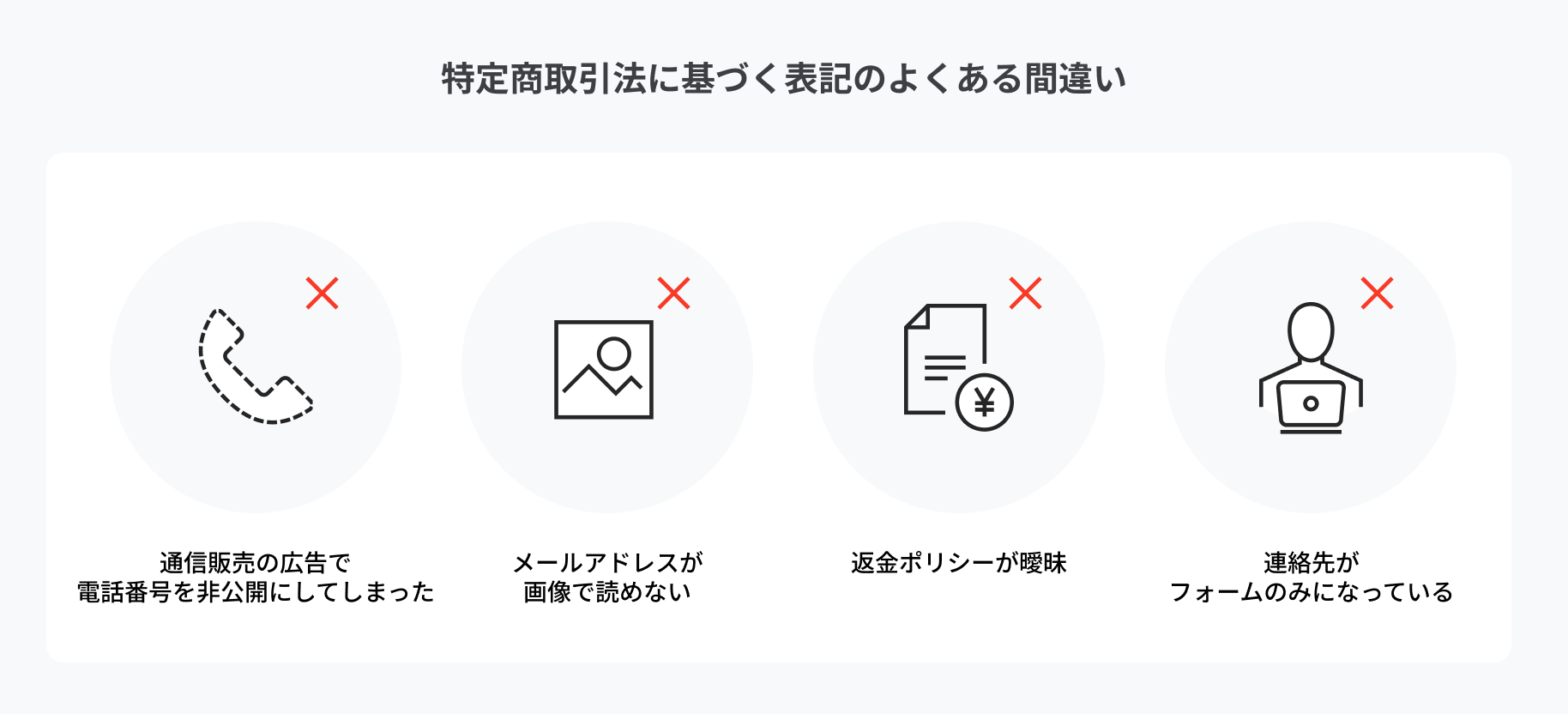
Common mistakes in notation based on the Specified Commercial Transactions Act

Common mistakes in notation based on the Specified Commercial Transactions Act

It is important to be careful when writing information based on the Specified Commercial Transactions Act, as there are some points that are easy to make mistakes in. We will explain common mistakes in writing information based on the Specified Commercial Transactions Act.

I withheld my phone number in a mail order ad.

When placing an advertisement for a mail order business, you must include the name, address, and telephone number of the business. Be aware that advertisements that do not include a telephone number are subject to government regulations.

The email address is unreadable in the image

In online shopping, e-commerce sites often display email addresses as images, making them difficult to read. Image text is difficult to read, and is not recommended for people with poor eyesight.

Refund policy is vague

Vague refund policies are also a common mistake in wording based on the Specified Commercial Transactions Act.

If your refund policy is vague, consumers will not know in what cases they can get a refund for their product or service. This can lead to problems, so make sure your refund policy is as clear as possible.

Contact is form only

Providing only a contact form for a business is also a common mistake under the Specified Commercial Transactions Act. For example, when advertising for mail order sales, a business must display its company name, address, and phone number in the advertisement. If only a contact form is provided, it may be subject to government regulations, so care must be taken.

How to write notation based on the Specified Commercial Transactions Law

Information required by the Specified Commercial Transactions Act is essential for e-commerce sites. If you want to include information required by the Specified Commercial Transactions Act, create a page on your e-commerce site about the store operator and include a link in the header or footer to communicate the information in an easy-to-understand manner to consumers.
Here, we will look at some of the items of description based on the Specified Commercial Transactions Act and how to write them.

Source: Consumer Affairs Agency, Transactions Division, "Specified Commercial Transactions Act Guide: Mail Order Sales"

Business name (name), etc.

As per the Specified Commercial Transactions Act, the name of the business operator must be listed. If the business operator is a corporation, the name listed on the register must be listed; nicknames, trade names, and website names are not permitted. In addition, if the business operator is a corporation, the name of the representative or the name of the person in charge of mail order business must be listed. On the other hand, if the business operator is a sole proprietor, the name listed on the family register or the trade name listed in the commercial register must be listed.

Business address, phone number

The business's address and telephone number must also be listed in accordance with the Specified Commercial Transactions Act. Whether you are a sole proprietor or a corporation, you must accurately list the address where you currently operate (in the case of a corporation, this is usually the same as the address on the company register) (the street number cannot be omitted), but you can also list the address of a rental office or virtual office. The telephone number must be one where you can be reliably contacted. In addition to the telephone number, clearly listing your website URL, email address (an email address is required when advertising by email), and available hours will help you gain consumer trust.

Selling price of goods

As a notation based on the Specified Commercial Transactions Law, in addition to the selling price of the item, the shipping fee (if the shipping fee is not stated separately, the shipping fee will be estimated to be included in the selling price), handling fee, wrapping fee Indicate the costs borne by the consumer. Be careful to clearly see the tax-included amount. If the shipping cost varies depending on the shipping address, it will be easier to see if you summarize it in a table. As long as the selling price and shipping cost of the product are stated on the page of each product, there is no problem even if it is omitted in the notation based on the Specified Commercial Transactions Law.

Payment method and timing of payment

As a notation based on the Specified Commercial Transactions Law, the payment method and payment time are indicated. The payment method must be clearly stated for all available methods. If you have multiple payment methods, be sure to specify when the payment will occur.

Product delivery time

As a notation based on the Specified Commercial Transactions Act, the delivery date of the product is indicated. The delivery date of the product refers to the time when the product will arrive at the consumer's place after receiving an order from the consumer, and it is necessary to indicate the period or deadline for the delivery date of the product.

Terms for returns and exchanges

In accordance with the Specified Commercial Transactions Act, you should state your rules regarding returns and exchanges. E-commerce sites do not have any provisions regarding cooling-off periods, but Article 15-3 of the Specified Commercial Transactions Act does have provisions regarding the cancellation of sales contracts in mail-order sales. However, if a business clearly states special terms regarding the withdrawal or cancellation of an application for a contract, these terms will apply. Therefore, if you do specify special terms, be sure to clearly state the conditions for returns and exchanges, who will be responsible for shipping costs, and so on, in accordance with the e-commerce site's rules.

In addition, information according to the product

In addition, as a notation based on the Specified Commercial Transactions Law, necessary information will be shown according to the product.
For example, when selling game software or PC applications, it is necessary to display the compatible models and operating environment. If you are dealing with a product that requires a permit or license, write down the details as well.

Example of notation based on the Specified Commercial Transactions Law

Below are some examples of how to display information in accordance with the Specified Commercial Transactions Act. Please refer to these examples and display information in accordance with the regulations for e-commerce sites.

■Example of notation based on the Specified Commercial Transactions Act

Distributor ◯◯ Co., Ltd.
Representative responsible ◯◯◯◯
Location 〒 ◯◯◯-◯◯◯◯
Tokyo ◯◯ ward ◯◯ ◯-◯-◯
telephone number 03-◯◯◯◯-◯◯◯◯
Telephone reception time 8:00〜17:00
email address ◯◯◯◯ @ ◯◯◯◯ .com
Site URL https://www.◯◯◯◯.com
Selling price The price is stated on the introduction page of each product.
Fees required in addition to the product price Consumption tax, shipping fee (nationwide uniform ◯◯◯ yen)
* Free shipping if you purchase over ◯◯◯ yen, wrapping fee ◯◯◯ yen (only for those who wish)
Delivery time We will ship within ◯ days of your order.
Payment method and timing of payment Credit Card Payment: Payment will be confirmed when you place an order.
C.O.D .: Please pay the price in cash to the delivery person when the item is delivered.
CVS Payment: Please pay at the convenience store within ◯ days of your order.
About returns / exchanges / cancellations Basically, we do not support returns, exchanges, or cancellations after the product has been shipped.
Please contact us as we can only replace the product if it is defective.
Return deadline Please contact us within ◯ days after the product is shipped.
Return shipping If the product is defective, we will bear it.
Other than that, it will be borne by the customer.
Secondhand dealer permit Tokyo [Permission number] No. ◯◯◯◯ [Sales manager] ◯◯◯◯


Please note that this is only an example for reference, so please refer to the following websites and create the information to be displayed according to the services of each merchants.

Mail Order Advertising | Mail Order | Specified Commercial Transactions Act Guide

Why SB Payment Service is chosen

In order to operate an e-commerce site, it is necessary to have a notation based on the Specified Commercial Transactions Act. In addition, notation based on the Specified Commercial Transactions Act is necessary information for customers to shop with peace of mind, so if it is notated, it will lead to peace of mind from customers.
In addition to complying with the law, preparing numerous payment methods to increase customer convenience is one way to increase the credibility of your e-commerce site.

SB Payment Service offers a wide variety of payment methods, including Credit Card Payment, Mobile Carrier Billing, CVS Payment, and mobile payments. We also provide "Marketing support" for news release distribution and other services to support the opening of e-commerce sites.
When considering opening an e-commerce site, please consult with SB Payment Service, which has a lot of experience.

FAQ

Q.
Where should I display the information required by the Specified Commercial Transactions Act?
A.
When displaying information required by the Specified Commercial Transactions Act, you must create a page about the store operator on your e-commerce site and include a link in the header or footer to communicate the information in a way that is easy for consumers to understand. This will allow consumers to easily check the information.
Q.
What happens if the content of the description based on the Specified Commercial Transactions Act is incorrect?
A.
Under the Specified Commercial Transactions Act, businesses that violate administrative regulations are subject to administrative sanctions such as orders to improve business practices, orders to suspend business, and orders prohibiting executives from engaging in business activities. Please note that some of these actions are also subject to penalties. Individuals subject to criminal penalties may face up to three years in prison or a fine of up to 3 million yen, or both.
Q.
Is it necessary for sole proprietors to make disclosures in accordance with the Specified Commercial Transactions Act?
A.
Yes, all e-commerce sites are subject to this law, regardless of the products they handle or the type of business they operate. Sole proprietors are also required to provide information in accordance with the Specified Commercial Transactions Act. If you are a sole proprietor, you must provide your name as recorded in your family register or the trade name as recorded in the commercial register.

If you have any other questions, please check the FAQ.

Editor information

SB Payment Service Editorial Department

SB Payment Services is a part of the SoftBank Group and handles payment operations. Since its establishment in 2004, the company has been introducing payment systems merchants a wide range of industries.
Our column continuously provides merchants with information that is useful not only for payment but also for e-commerce site operations and business.

For payment agency
SB Payment Service

Comprehensive proposals in a wide range of business areas and a proven track record of being consistently chosen
Abundant payment services with more than 40 brands to meet your needs

Reliability and thoroughness of international brand members
Security & Support

Introduction of related services

  • Online Payment Service

    Compatible with any business or device,
    Provide a safe and smooth online payment experience

    View service information
  • Payment services for in-stores

    Supports a wide range of payment methods and supports store management.
    Contribute to smartness

    View service information
  • Can be linked
    EC cart package

    Supports over 20 types of EC carts.
    Payment can be implemented with little development burden

    View compatible systems

About SB Payment Service


TOP