Press Releases


We have published the results of our survey regarding the status of considerations and implementation of overseas sales, as well as payment methods
64.4% of companies that conduct overseas sales report experiencing burdens due to differences in operations across countries and regions.
April 23, 2026
SB Payment Service Corp.
SB Payment Service Corp. (Minato-ku, Tokyo; President & CISO: Tomonori Hotta), a subsidiary of SoftBank Corp., has entered into a business and capital alliance with NOMU PAY LIMITED (Dublin, Republic of Ireland; Group CEO: Peter Burridge; hereinafter "Nomupay"), which provides local payment and payment infrastructure in the EU and Asia, to support businesses aiming for global expansion. To understand the current status of considerations and implementations regarding overseas sales and the actual situation regarding payment methods, we have conducted a survey. We are pleased to announce excerpts of the results.
- Survey Name
- Survey on the status of considerations and implementation of overseas sales and actual payment methods
- Survey method
- Internet research
- Study area
- Nationwide
- Survey period
- December 19, 2025 - January 16, 2026
- Survey participants
- 1,004 overseas business managers from companies that are currently conducting or considering conducting overseas sales (sales through overseas branches, e-commerce sites, platforms, or e-commerce marketplaces).
- Implementing body
- SB Payment Service Corp.
- For companies currently selling overseas, the top source of advice is the Japan External Trade Organization (JETRO) (31.5%), while for companies considering overseas sales, the top source of advice is consulting firms (23.9%).
- 64.4% of companies that sell in multiple countries have experienced burdens due to differences in operations across countries and regions.
- The top challenge for companies currently selling overseas products was "complying with laws and regulations and compliance" (33.8%), while for companies considering overseas operations, it was "insufficient Japanese language support during implementation and operation" (22.8%).
- For overseas sales, common payment methods include PayPal and Apple Pay in North America, Apple Pay in Europe, and local QR code/ Electronic money in China and other parts of Asia.
- The challenges related to payments in overseas sales are: "high payment, remittance, and exchange fees" (31.9%), "fraud prevention and security measures" (31.2%), and "payment cycle and cash flow" (27.6%).
- 47.5% of companies reported that they had not yet addressed payment-related challenges in overseas sales. This figure was particularly high (55.0%) for sales at overseas locations compared to e-commerce sites and marketplaces. The countries/regions where these challenges were most severely lacking were the Middle East and Africa (19.4%), China (18.8%), and East Asia and Southeast Asia (17.0%).
- Within the next five years, 43.5% of companies overall, and over 50% of companies in the trading/wholesale, retail, and food service sectors, plan to expand or are considering expanding their overseas sales.
The results of this survey reveal that while the number of companies starting overseas sales is increasing, the optimization of payment systems and their implementation across different countries and regions is still insufficient. In particular, differences in legal regulations and business practices across countries and regions appear to be a structural challenge for companies expanding globally.
<Survey Results>
For companies currently selling overseas, the top source of advice is the Japan External Trade Organization (JETRO) (31.5%), while for companies considering overseas sales, the top source of advice is consulting firms (23.9%).
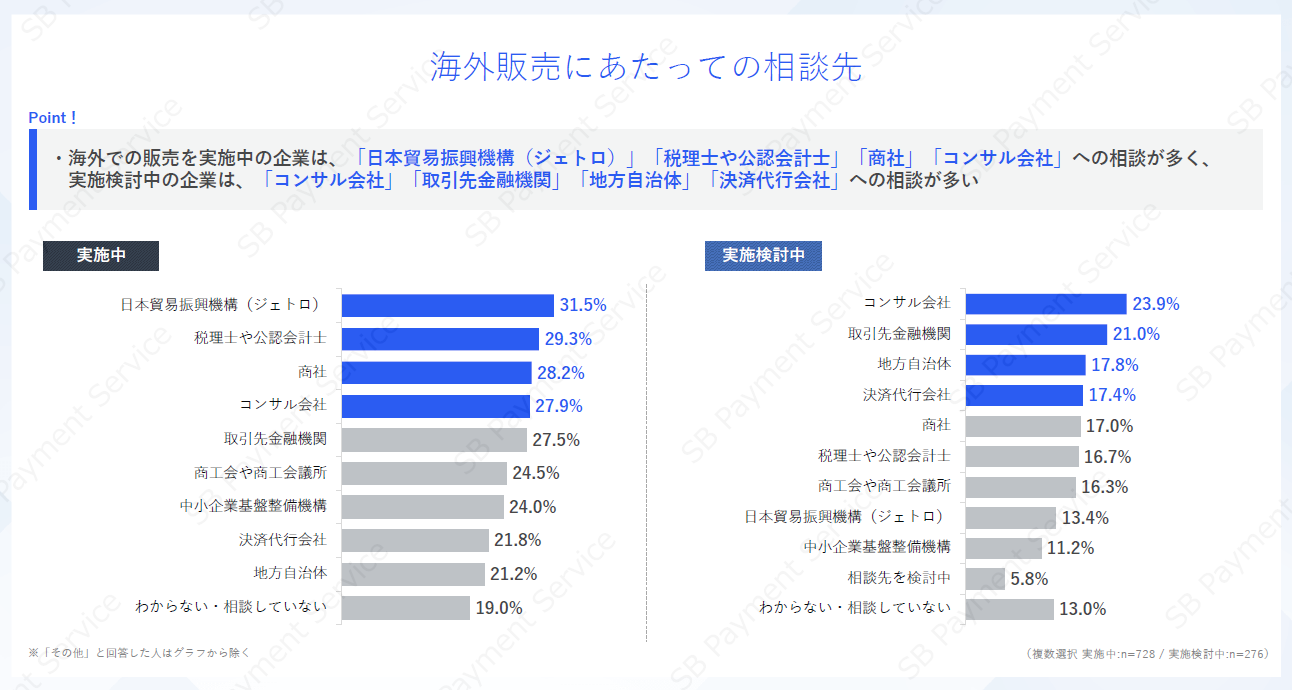
When asked if they consulted with any organizations when implementing or considering overseas sales, companies currently implementing overseas sales most frequently cited "Japan External Trade Organization (JETRO)" (31.5%), "tax accountants and certified public accountants" (29.3%), "trading companies" (28.2%), and "consulting firms" (27.9%). For companies considering overseas sales, "consulting firms" (23.9%), "financial institutions" (21.0%), and "local governments" (17.8%) were the most frequently cited, followed by "PSP companies" at 17.4%.
64.4% of companies that sell in multiple countries have experienced burdens due to differences in operations across countries and regions.
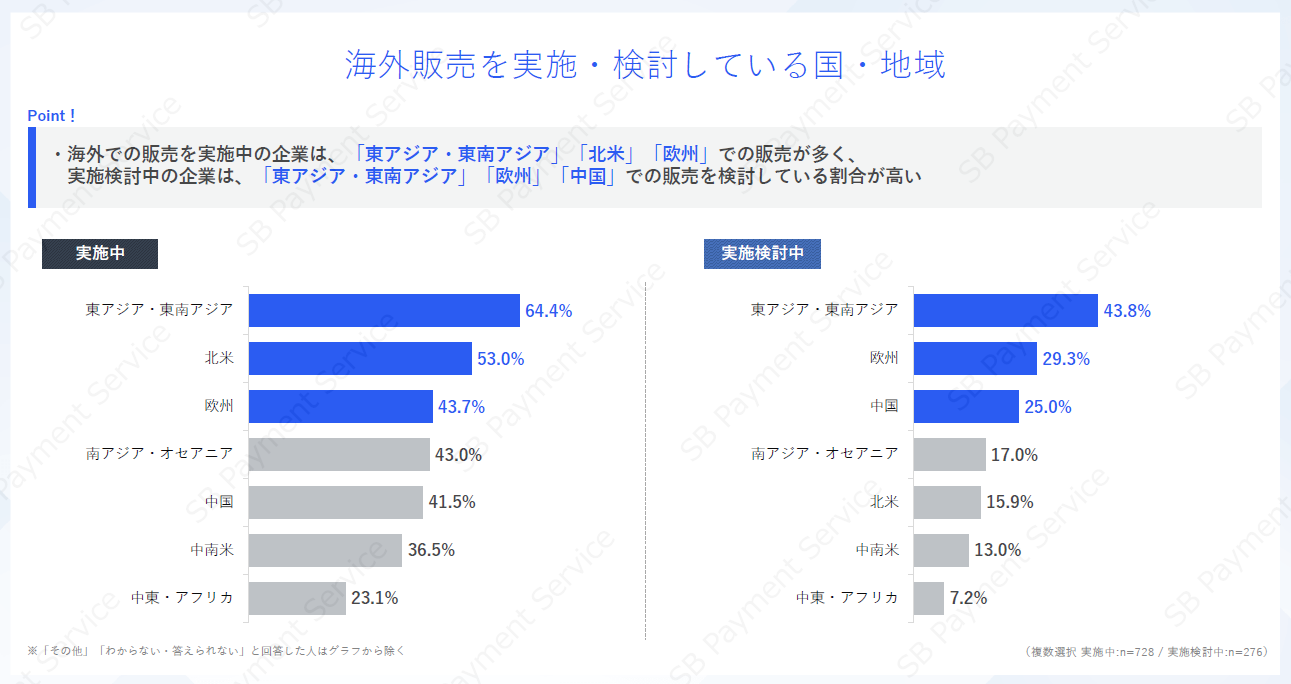
When asked about the countries and regions where they are currently selling or considering selling overseas, it was found that among companies currently selling overseas, the proportion of those selling in "East Asia and Southeast Asia" (64.4%), "North America" (53.0%), and "Europe" (43.7%) was high, while among companies considering selling overseas, the proportion of those considering selling in "East Asia and Southeast Asia" (43.8%), "Europe" (29.3%), and "China" (25.0%) was high.
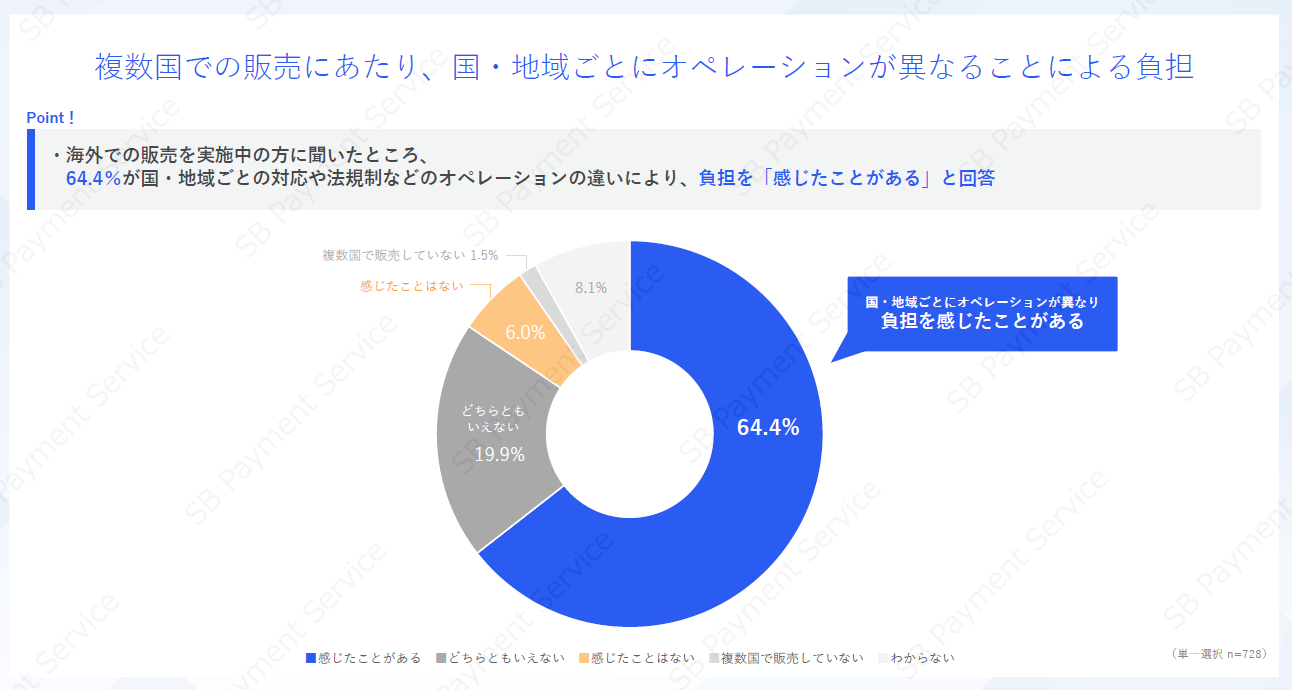
When we asked those currently selling overseas whether they had ever felt burdened by the differences in operational procedures, legal regulations, etc., from country to country or region to country when selling in multiple countries, 64.4% answered "yes." On the other hand, only 6.0% answered "no," a difference of more than 10 times.
The top challenge for companies currently selling overseas products was "complying with laws and regulations and compliance" (33.8%), while for companies considering overseas operations, it was "insufficient Japanese language support during implementation and operation" (22.8%).
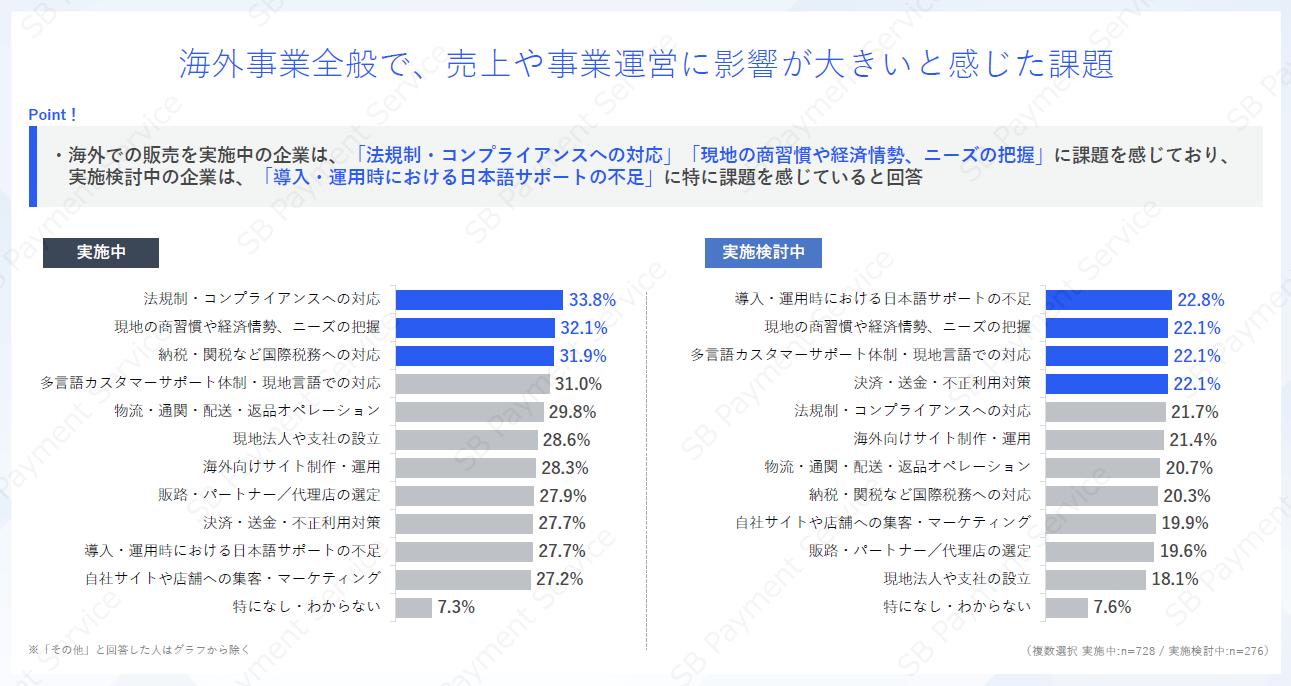
When asked about the challenges they feel have a significant impact on sales and business operations in their overseas business in general, companies currently selling overseas cited "complying with laws and regulations and compliance" (33.8%) and "understanding local business practices, economic conditions, and needs" (32.1%) as the top concerns. On the other hand, companies considering selling overseas cited "lack of Japanese language support during implementation and operation" (22.8%) as the most common concern.
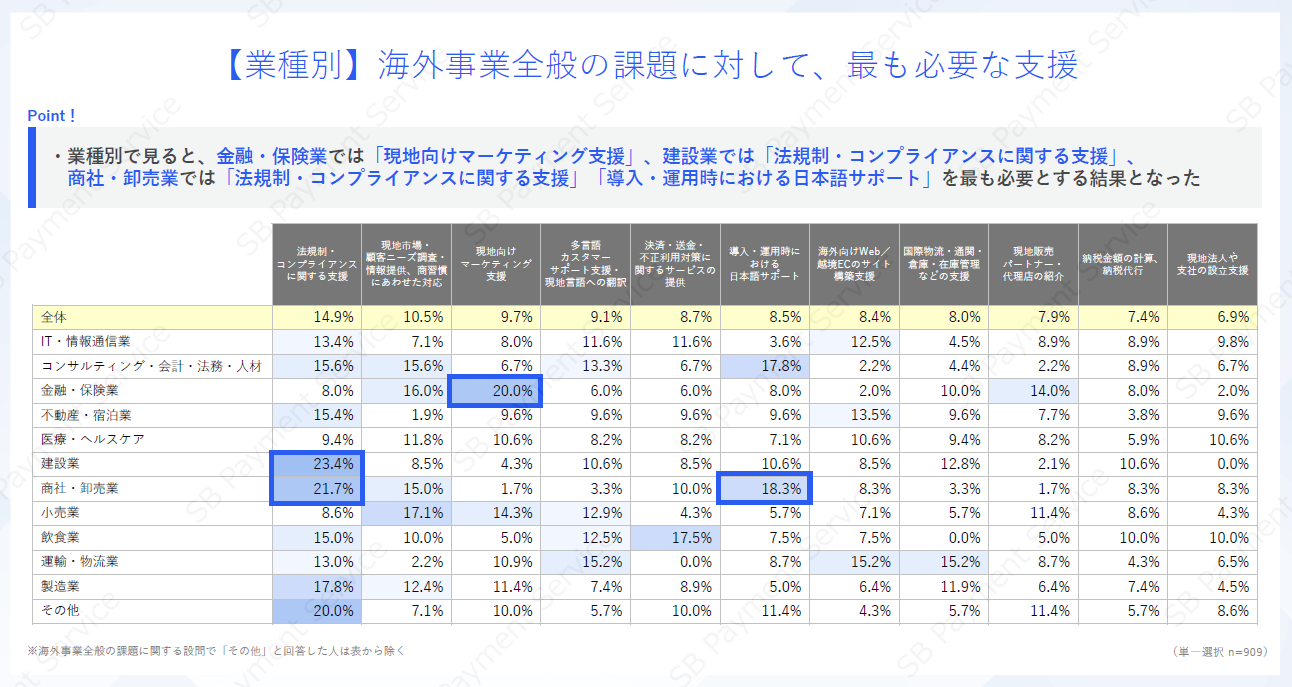
When asked about the most needed support to address challenges in their overseas operations, "support regarding legal regulations and compliance" was the top answer overall at 14.9%. This was followed by "local market and customer needs research, information provision, and adaptation to business practices" (10.5%) and "local marketing support" (9.7%). Broken down by industry, the financial and insurance industry cited "local marketing support" (20.0%) as the most needed support, the construction industry cited "support regarding legal regulations and compliance" (23.4%), and trading companies and wholesalers cited "support regarding legal regulations and compliance" (21.7%) and "Japanese language support during implementation and operation" (18.3%) as the most needed support.
For overseas sales, common payment methods include PayPal and Apple Pay in North America, Apple Pay in Europe, and local QR code/ Electronic money in China and other parts of Asia.
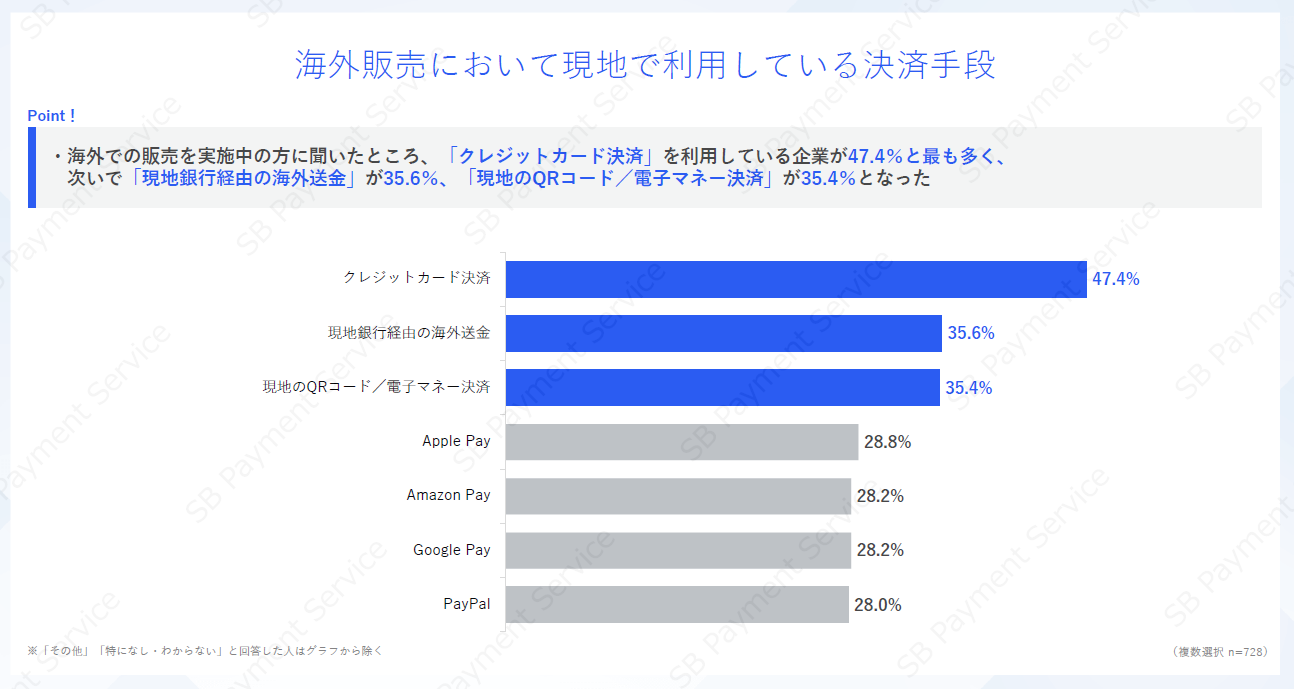
When we asked those who are selling overseas what payment methods they are currently using locally, 47.4% of companies use "Credit Card Payment", followed by "overseas remittance via local bank" at 35.6%, and "local QR code/ Electronic money" at 35.4%. It can be seen that not only credit cards but also local payments that are rooted overseas tend to be introduced.
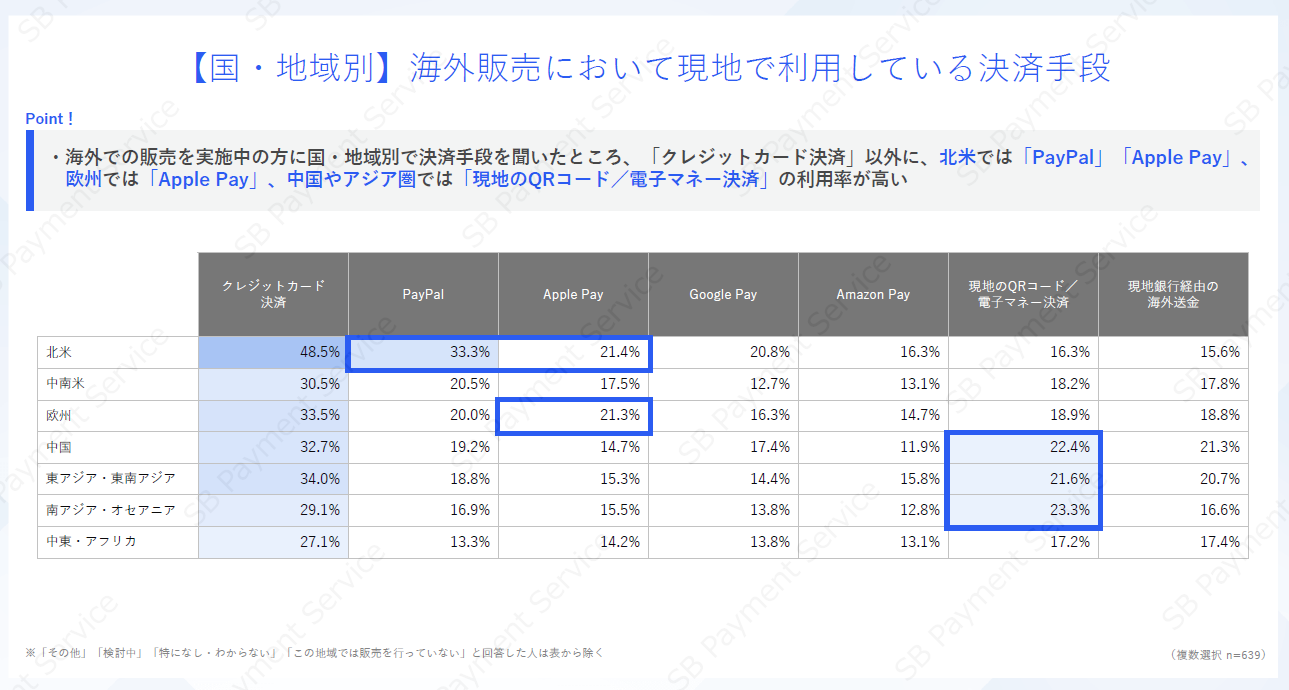
When we asked people who are currently selling overseas about payment methods they use in each country/region, we found that, aside from "Credit Card Payment," "PayPal" and "Apple Pay" are commonly used in North America, and "Apple Pay" is also commonly used in Europe. In contrast, "local QR code/ Electronic money" are frequently used in China, East Asia, Southeast Asia, South Asia, and Oceania.
The challenges related to payments in overseas sales are: "high payment, remittance, and exchange fees" (31.9%), "fraud prevention and security measures" (31.2%), and "payment cycle and cash flow" (27.6%).
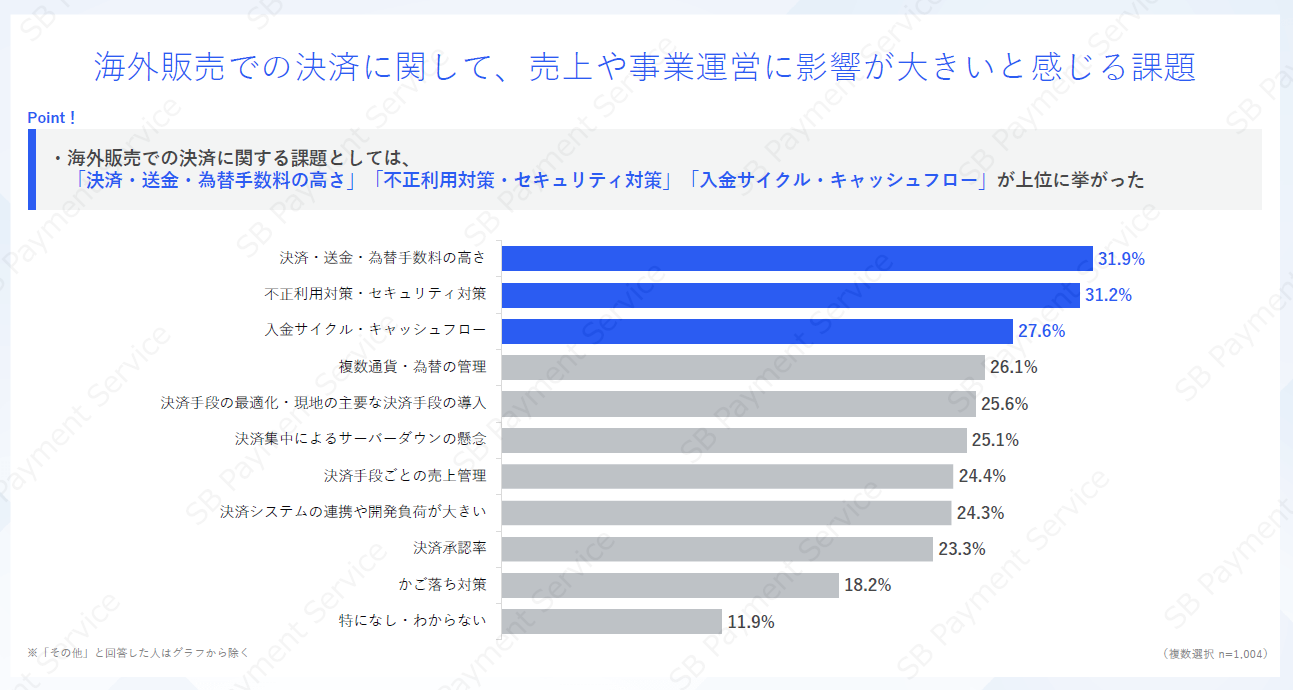
When asked about any issues related to payments in overseas sales that they felt had a significant impact on sales and business operations, the most common response was "high payment, remittance, and foreign exchange fees" (31.9%), followed by "fraud prevention and security measures" (31.2%), and "payment cycle and cash flow" (27.6%).
47.5% of companies reported that they had not yet addressed payment-related challenges in overseas sales. This figure was particularly high (55.0%) for sales at overseas locations compared to e-commerce sites and marketplaces. The countries/regions where these challenges were most severely lacking were the Middle East and Africa (19.4%), China (18.8%), and East Asia and Southeast Asia (17.0%).
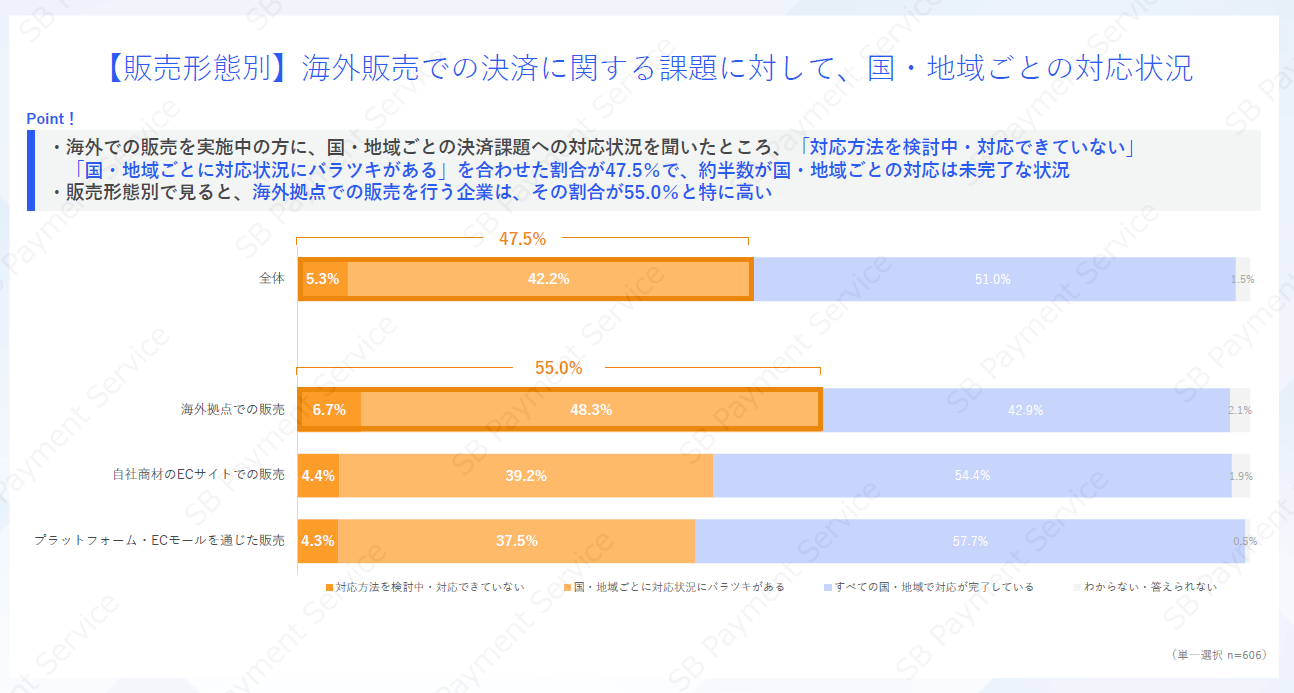
When we asked companies currently selling overseas about their current status regarding payment-related challenges, 47.5% responded that they were "considering or unable to address" or that "there are variations in the status of support from country to country/region." This indicates that approximately half of companies have not yet completed country-specific support. Looking at this by sales method, the percentage was particularly high at 55.0% for companies selling through overseas bases. This suggests that companies operating with local bases in each country/region are unable to adequately address the differences in operations and legal regulations that arise in each country/region.
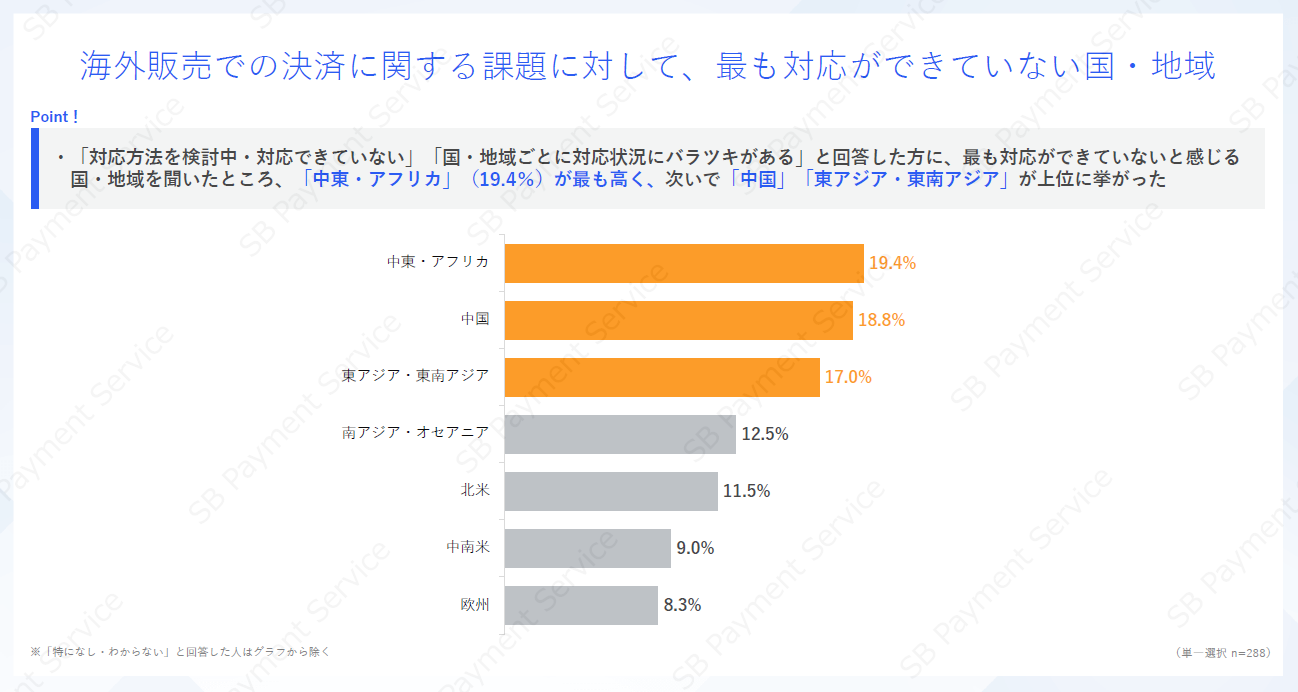
When asked which country or region they felt was the least addressed regarding payment-related issues, those who responded that they were "considering or unable to address" or that "there are variations in the status of addressing these issues across countries/regions" were asked to identify the country or region where they felt the issues were most inadequately addressed. The most common response was "Middle East and Africa" (19.4%), followed by "China" (18.8%) and "East Asia and Southeast Asia" (17.0%).
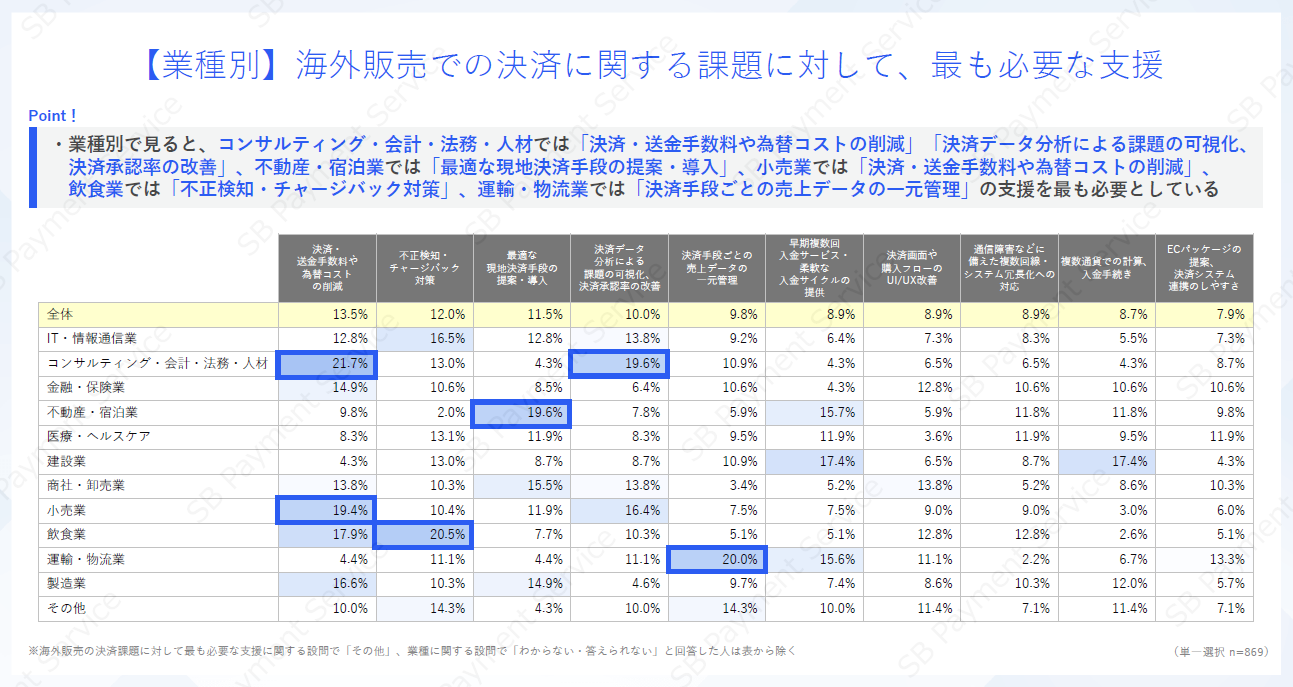
When asked about the most needed support for payment-related challenges in overseas sales, the most common response overall was "reduction of payment/remittance fees and exchange rate costs" (13.5%), followed by "fraud detection and chargeback prevention" (12.0%) and "proposal and implementation of optimal local payment methods" (11.5%). Broken down by industry, the most needed support was found in consulting, accounting, legal, and human resources ("reduction of payment/remittance fees and exchange rate costs" 21.7%) and "visualization of issues and improvement of payment approval rates through payment data analysis" 19.6%), in real estate and hospitality ("proposal and implementation of optimal local payment methods" 19.6%), in retail ("reduction of payment/remittance fees and exchange rate costs" 19.4%), in food and beverage ("fraud detection and chargeback prevention" 20.5%), and in transportation and logistics ("centralized management of sales data for each payment methods" 20.0%).
Within the next five years, 43.5% of companies overall, and over 50% of companies in the trading/wholesale, retail, and food service sectors, plan to expand or are considering expanding their overseas sales.
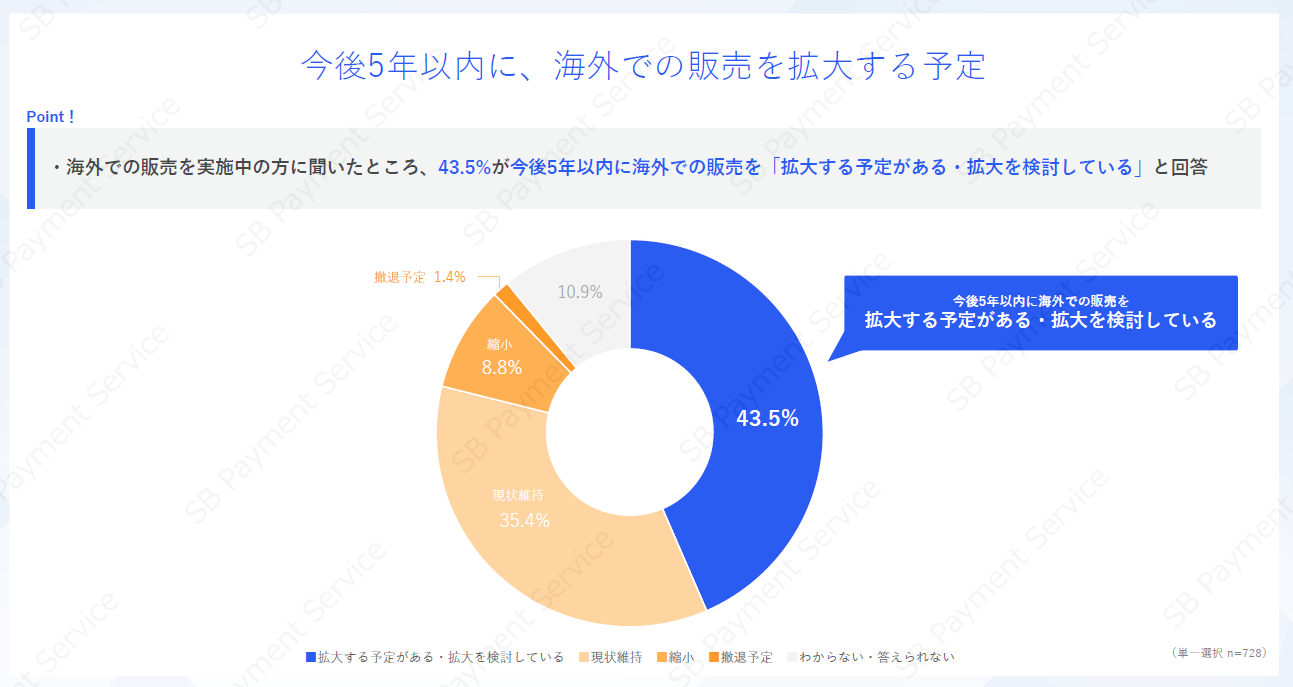
When we asked those currently selling overseas whether they plan to expand their overseas sales within the next five years, 43.5% responded that they "plan to expand or are considering expanding."
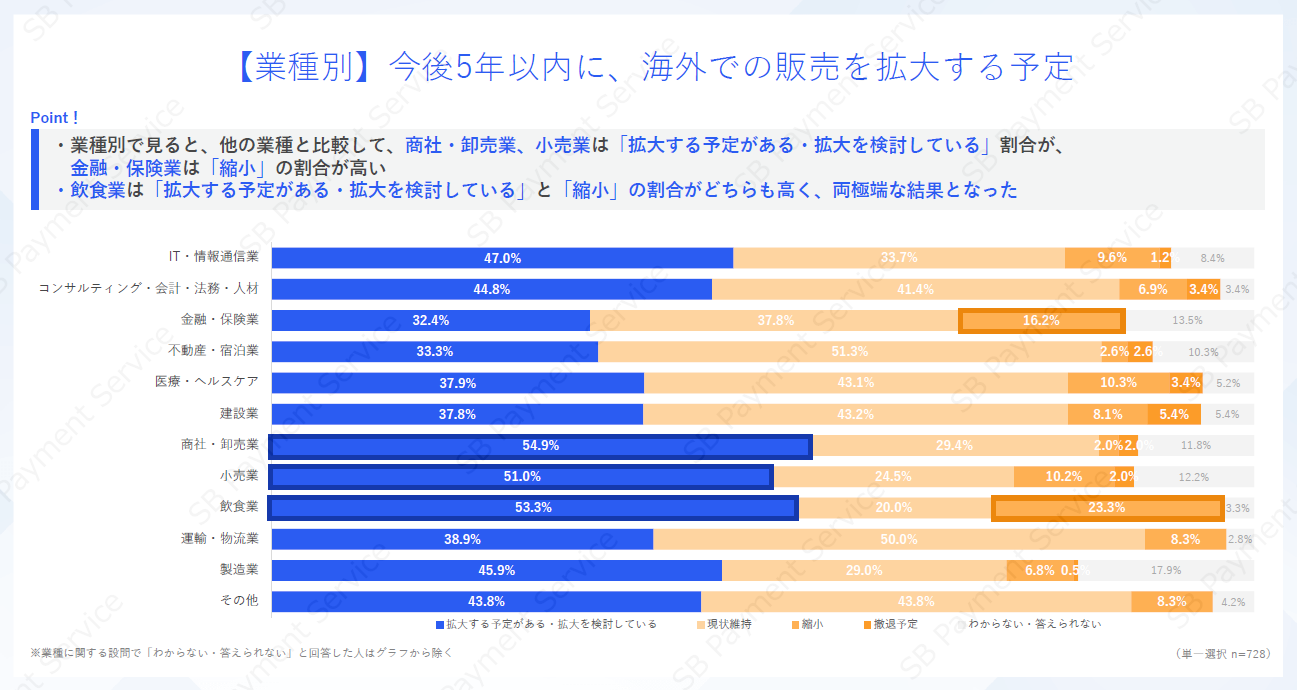
Looking at the results by industry, we found that trading companies/wholesale businesses and retail businesses had a high percentage of companies "planning to expand or considering expansion," while the finance and insurance industry had a high percentage of companies "declining." In addition, the food and beverage industry had high percentages of companies "planning to expand or considering expansion" and "declining," indicating that companies may be pursuing policies at either extreme.
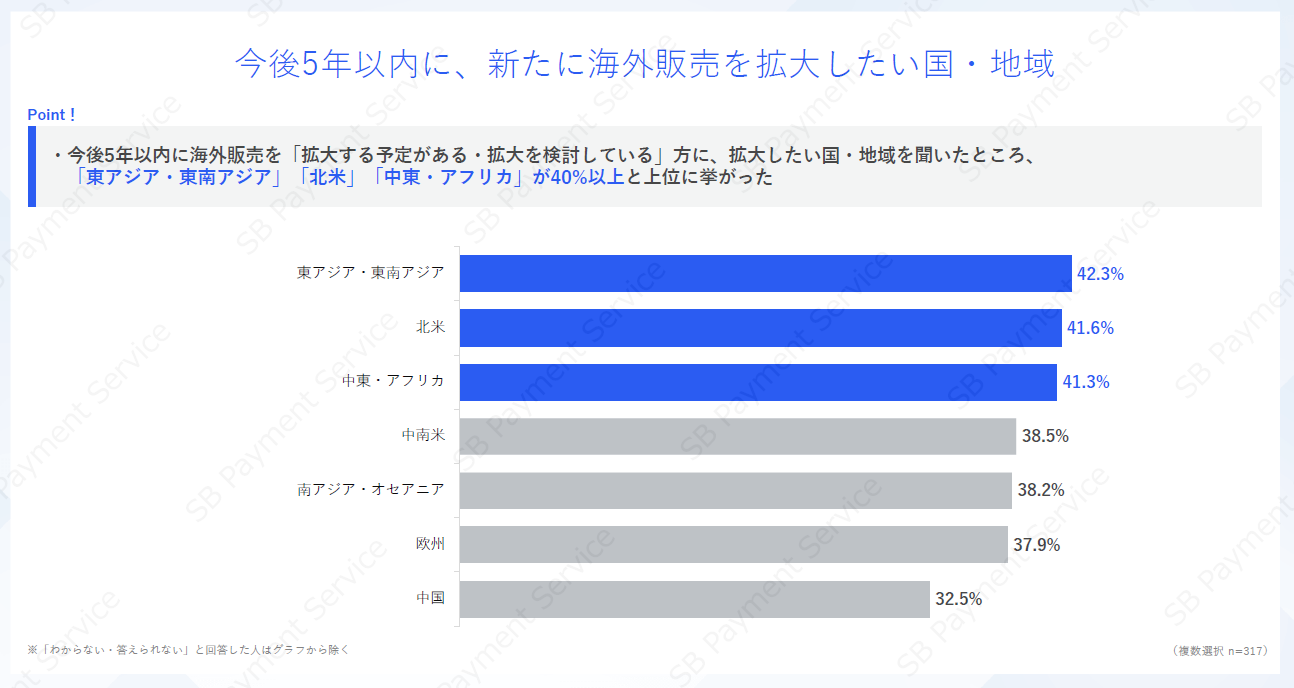
When those who answered that they "plan to expand or are considering expanding" overseas sales within the next five years were asked which countries/regions they would like to expand into, "East Asia/Southeast Asia" was cited by 42.3%, "North America" by 41.6%, and "Middle East/Africa" by 41.3%. This suggests that these countries/regions are of high interest as future growth markets.
On the other hand, this survey revealed that many companies face challenges in handling payment methods in different countries and regions, suggesting that improving the payment infrastructure is a crucial factor in expanding overseas sales.
SB Payment Service Corp. is collaborating with Nomupay to support businesses considering expansion into the global market. Please feel free to contact us for more details.
You can download the full survey results here.
Copyright
・You are free to reproduce both the illustrations and text from this survey.
- The copyright of this survey belongs to SB Payment Service Corp., but permission to use it is granted to those who meet the following conditions of use.
Terms of use
- 1. Clearly state the name of "SB Payment Service Corp." as the source of the information.
- 2. Include a link to the following URL as the source.
https://www.sbpayment.jp/news/press/2026/20260423_001545/ - 3. Use the survey results data without processing or alteration.
- 4. We will comply with requests to discontinue posting if we deem it inappropriate.
- "QR Code" is a registered trademark of Denso Wave Incorporated.
- Other company names and product/service names mentioned are trademarks or registered trademarks of the respective companies.
Company Profile
SB Payment Service Corp.
| Representative | Tomonori Hotta, President & CISO |
|---|---|
| Location | 1-7-1 Kaigan, Minato-ku, Tokyo Tokyo Port City Takeshiba Office Tower |
| Established | October 1, 2004 |
| Business content | Payment service, collection agency and corporate calculation office work, acquiring (card merchant business) business, issuing (card issuing business) business |
| URL | https://www.sbpayment.jp/en/gl-top/ |
Inquiries regarding business expansion in the global market
SB Payment Service Corp.
| Inquiry form | https://www.sbpayment.jp/en/contact/contact-en/ |
|---|
Inquiries from the media regarding this matter
SB Payment Service Corp. Public Relations
| Inquiry form | https://www.sbpayment.jp/en/contact/contact-en/ |
|---|
- インフォメーション 2026年
- インフォメーション 2025年
- インフォメーション 2024年
- インフォメーション 2023年
- インフォメーション 2022年
- インフォメーション 2021年
- インフォメーション 2020年
- インフォメーション 2019年
- インフォメーション 2018年
- インフォメーション 2017年
- インフォメーション 2016年
- インフォメーション 2015年
- インフォメーション 2014年
- インフォメーション 2013年
- インフォメーション 2012年
- インフォメーション 2011年
- インフォメーション 2010年
- インフォメーション 2009年
- インフォメーション 2008年
- インフォメーション 2007年